Michael Dominick
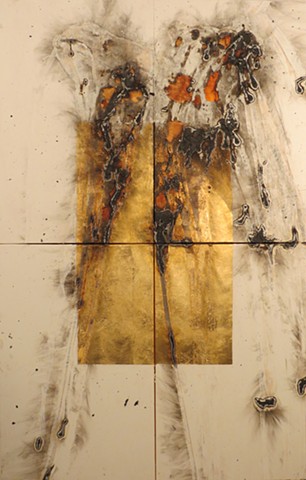
I have recently begun to create a series of molten iron drawings. Unlike the gun powder drawings of Cai Guo-Qiang and the action painting of Jackson Pollack, my molten iron drawings honestly reflect the spontaneity of their making. There is little advanced planning outside of treating the archival paper with a liquid compound of my own creation. This leaves the surface remarkably resistant to the 2800 degree molten iron. The resulting gestural strokes and splashes, persuading the liquid fire on its collision course with the picture plane, create beautiful, yet unpredictable marks that not only scorch the surface, but also burn into the depth of the layers of treated paper and the plaster support structure. No two are the same, and each one successfully captures the chaos of the moment in a dynamic, spontaneous and visually compelling manner. Here, molten iron acts as a brush leaving behind complex, scorched gestures that permanently seal the instant of their making. Each drawing bears the marks of the controlled chaos that brought it into existence.

My sculptural work focuses on the elements of water, fire & heat, air & steam and earth & iron in an effort to more inclusively involve the process of iron melting (fire and earth) and re-direct the focus of the work more closely towards the notion of that which is ephemeral (air, steam and heat). The concepts of forgotten memories and lessons once learned are universal. I make these themes resonate with hypnotic frequency as one gazes upon water dripping steadily into a heated iron basin creating a steady cadence of audible hissing. It is at this juncture that the life giving compound vaporizes into nothingness like a memory lost forever

In a previous series of heat generating & radiator sculptures I was presenting a new kind of readymade that contradicts one of the basic conditions of the genre. The tradition of the readymade has been predicated on its removal from a utilitarian context. By going a step further I made my radiator sculptures generate heat as was their purpose. Rather than simply borrowing an object and placing it on a pedestal I additionally restored and appropriated its original function and transformed that into a formal quality of the work.

These sculptures denied my audience the option of non-involvement. Casual observers may choose to ignore a typical work of art, but they cannot deny the feeling of warmth against their skin. This quality surrounds the viewer and forces them to engage the work through the inescapable sensation of heat thus rupturing the typical boundaries of art perception.